
When planning a modular kitchen, the first number most homeowners compare is the initial price. A wooden kitchen may appear more affordable upfront, while a premium stainless steel kitchen can require a higher initial investment.
But is the cheaper kitchen actually cheaper after 10, 15, or 25 years?
The answer depends on lifecycle cost—not simply the amount you pay on installation day. Maintenance, repairs, potential replacement, inflation, warranty coverage, and residual value can significantly change the long-term economics of a kitchen.
For homeowners comparing a stainless steel modular kitchen in Bangalore with a conventional wood-based modular kitchen, understanding this difference can lead to a more informed investment.
Stainless Steel vs Wooden Kitchen — Which Is Cheaper Over Time?
A wooden modular kitchen can cost less initially, while a stainless steel kitchen can offer better long-term value because of its durability and lower maintenance requirements.
For example, in Tusker Kitchens’ illustrative 25-year lifecycle-cost comparison:
- Wooden kitchen initial cost: upto ₹3.5 lakh
- Tusker steel kitchen initial cost: around ₹6 lakh
- Wooden kitchen assumed replacement: after 10 years
- Tusker kitchen: 25-Year Written Guarantee
- Estimated 25-year cost shown for the wooden kitchen: upto ₹14.35 lakh
- Estimated 25-year cost shown for the Tusker steel kitchen: around ₹5.25 lakh
These figures are an illustrative scenario based on stated assumptions, including 6% annual inflation, maintenance, replacement timing, and estimated resale value. Actual costs will vary by kitchen size, specification, usage, material, maintenance, and market conditions.
The important takeaway is simple: compare the total cost of owning the kitchen, not only its starting price.
What Is the Lifecycle Cost of a Modular Kitchen?
The lifecycle cost of a kitchen is the total amount a homeowner may spend on it throughout its useful life.
It can include:
Initial purchase + maintenance + repairs + future replacement − residual/resale value
This provides a more meaningful comparison than simply asking which kitchen has the lowest quotation today.
Why Wooden Kitchens Often Look Cheaper Initially
Plywood, MDF, particle board, and other wood-based products are widely available across different price categories.
This allows homeowners to build a modular kitchen at a relatively accessible initial price.
However, the upfront quotation doesn’t necessarily represent the complete cost of owning that kitchen.
Depending on material quality and conditions, future expenses can include:
- Termite treatment
- Water-damaged cabinet repairs
- Laminate or edge-band replacement
- Hardware repairs
- Replacement of damaged panels
- Partial or complete kitchen renovation
Not every wooden kitchen will experience these problems, and high-quality plywood can perform well when properly manufactured and maintained. The important distinction is that wood-based materials remain more sensitive to moisture and biological attack than stainless steel.
Where Stainless Steel Changes the Cost Equation
A stainless steel kitchen usually requires a larger initial investment because the underlying material, engineering, manufacturing, and construction are different.
The advantage becomes clearer when the kitchen is evaluated over a longer period.
1. No Termite Damage to the Steel Structure
Termites cannot consume stainless steel. This removes one of the major structural risks associated with wood-based kitchen cabinets.
2. No Swelling from Water Absorption
Stainless steel does not absorb water like wood-based boards can. This is particularly valuable around sinks, utility areas, and other moisture-prone zones.
3. Lower Structural Maintenance
Steel does not require termite treatment, polishing, or replacement because of swelling or warping.
Hardware, finishes, countertops, and accessories can still require normal servicing or replacement, but the steel cabinet structure itself is designed for long-term use.
4. Longer Replacement Cycle
A kitchen that remains structurally sound for longer can delay or eliminate the need for a major cabinet replacement—one of the largest potential expenses in kitchen ownership.
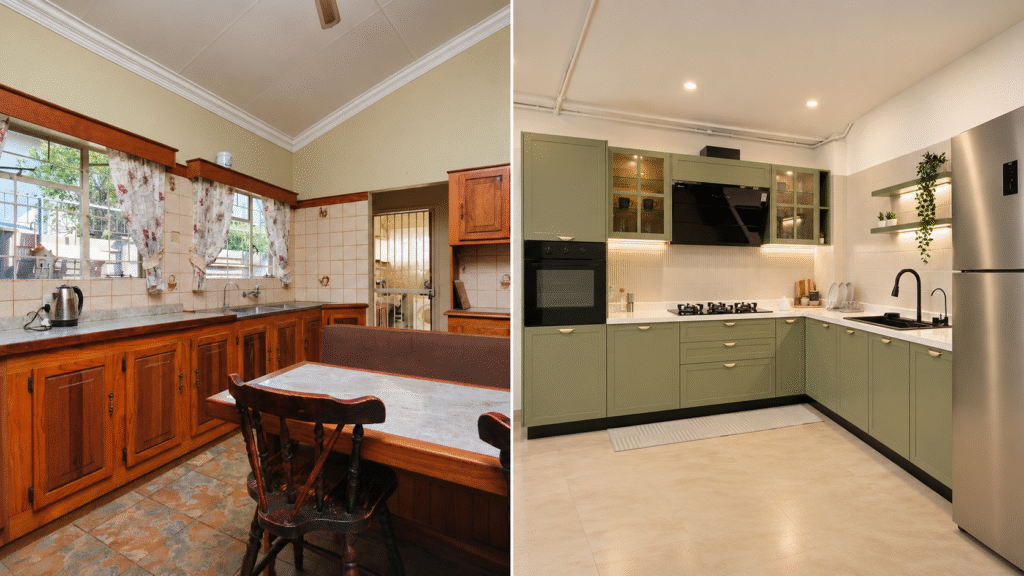
Stainless Steel Kitchen vs Wooden Kitchen: Long-Term Comparison
| Factor | Stainless Steel Kitchen | Wood-Based Kitchen |
| Initial investment | Generally higher | Generally lower |
| Water absorption | Does not absorb water | Depends on board and protection |
| Termite risk to cabinet material | No | Possible |
| Swelling/warping | Not from moisture absorption | Possible with prolonged moisture exposure |
| Structural maintenance | Low | Depends on material and conditions |
| Hygiene | Non-porous and easy to clean | Depends on surface and condition |
| Replacement risk | Lower with quality construction | Depends heavily on material, exposure and maintenance |
| Long-term value | Strong | Varies considerably |
A ₹3.5 Lakh Kitchen vs a ₹6 Lakh Kitchen: Look Beyond Day One
Consider the scenario illustrated in Tusker’s lifecycle-value comparison.
A wooden kitchen costing around ₹3.5 lakh appears significantly cheaper than a ₹6 lakh Tusker steel kitchen on the day of purchase.
But the calculation changes if the wooden kitchen requires substantial maintenance and eventually needs replacement.
The Tusker example evaluates ownership over 25 years and factors in:
- Initial investment
- Inflation at an assumed 6% per annum
- Repairs and maintenance
- Replacement
- Estimated residual/resale value
Under those specific assumptions, the illustration calculates a ₹14.35 lakh 25-year cost for the wooden kitchen versus ₹5.25 lakh for the Tusker steel kitchen.
This should not be interpreted as a universal saving for every homeowner. Rather, it demonstrates why future replacement and maintenance costs need to be included when comparing kitchen prices.
Inflation Makes Future Replacement More Expensive
This is one of the most overlooked aspects of kitchen pricing.
If a kitchen purchased today needs to be replaced 10 or 15 years later, homeowners will not be replacing it at today’s prices.
Materials, manufacturing, labour, hardware, logistics, and installation costs can all change over time.
That means a kitchen with a lower purchase price but a shorter replacement cycle can potentially become more expensive over the full period of home ownership.
This is why lifecycle value matters more than upfront price alone.
Why SS304 Matters in a Stainless Steel Kitchen
Not every steel kitchen is necessarily the same.
When comparing stainless steel kitchen manufacturers in Bangalore, homeowners should ask about the actual steel grade being used.
Tusker Kitchens uses 304 Food-Grade Stainless Steel for its stainless steel kitchen systems. SS304 is widely valued for its combination of corrosion resistance, durability, hygiene, and suitability for food-related environments.
A meaningful comparison should therefore consider not simply “steel vs wood”, but also:
- Steel grade
- Cabinet construction
- Sheet specifications
- Manufacturing quality
- Hardware
- Finishes
- Warranty terms
- Installation quality
This is also why working with experienced stainless steel kitchen interior designers in Bangalore matters when evaluating a long-term kitchen investment.
Check why stainless steel wins: Why Choose a Stainless Steel Kitchen?
What Does a Stainless Steel Modular Kitchen in Bangalore Cost?
There is no single fixed stainless steel modular kitchen Bangalore price because every kitchen has different dimensions and requirements.
Cost typically depends on:
- Kitchen size and layout
- Number of cabinets
- Stainless steel specifications
- Shutter finishes
- Internal accessories
- Hardware
- Countertop selection
- Appliance integration
- Customisation
Tusker Kitchens’ premium stainless steel kitchens start from approximately ₹3 lakh*, with the final quotation depending on the design and specifications selected.
Rather than comparing only the lowest quotation, homeowners should request a detailed specification and understand exactly what is included.
What Should You Ask Before Comparing Kitchen Prices?
Before choosing between different kitchen brands or steel interiors in Bangalore, ask:
- What material is used inside the cabinets?
- What grade of stainless steel or plywood is being offered?
- What exactly does the guarantee cover?
- What maintenance could be required over the next 10–25 years?
- How does the material perform around water and humidity?
- Is termite damage covered?
- What hardware and accessories are included?
- What costs are excluded from the quotation?
Two kitchens that look similar externally can have completely different structures, specifications, and lifecycle costs.
Where Tusker Steel Kitchens Fits into the Comparison
Tusker Kitchens approaches kitchen design from a long-term material and engineering perspective.
Its kitchens are built using 304 Food-Grade Stainless Steel and come with a 25-Year Written Guarantee, subject to the applicable warranty terms.
The focus is on solving everyday concerns faced in Indian kitchens, including:
- Water and moisture exposure
- Termites and pests
- Heat and heavy cooking
- Hygiene
- Structural durability
- Long-term maintenance
For homeowners searching for a stainless steel modular kitchen in Bangalore, the objective should therefore be to compare not just how much a kitchen costs today, but how much value it can deliver throughout its usable life.
Beyond durability, hygiene and ease of maintenance are important factors when comparing kitchen materials. Stainless steel has a non-porous surface that is easy to clean and maintain, making it suitable for everyday kitchen environments.
Explore the benefits of stainless steel in modern kitchens to understand why material selection matters for long-term performance.
So, Which Is Actually Cheaper Over Time?
There isn’t one universal cost figure that applies to every wooden or stainless steel kitchen.
A well-made wooden kitchen can perform effectively for many years, while a poorly manufactured steel kitchen may not deliver the expected value either.
But when comparing equivalent-quality kitchens, stainless steel has inherent advantages against termites, moisture absorption, swelling, and structural deterioration. Those characteristics can substantially reduce some of the major long-term risks and expenses associated with kitchen ownership.
So the smarter question isn’t:
“Which kitchen is cheaper today?”
It is:
“What will this kitchen cost me over the years I plan to use it?”
For a kitchen expected to remain part of the home for decades, that difference matters.
Frequently Asked Questions
Is a stainless steel kitchen more expensive than a wooden kitchen?
Generally, a premium stainless steel kitchen has a higher upfront cost than a basic wood-based modular kitchen. However, its lower structural maintenance requirements and longer replacement cycle can improve its lifecycle value.
Is a stainless steel modular kitchen worth the cost?
It can be particularly valuable for homeowners prioritising durability, hygiene, moisture resistance, termite protection, and long-term usage.
What affects stainless steel modular kitchen cost in Bangalore?
Kitchen dimensions, layout, steel specifications, shutters, hardware, storage accessories, countertops, appliances, and customization all affect the final price.
Does stainless steel require maintenance?
Yes, every kitchen requires routine cleaning and hardware upkeep. However, stainless steel cabinet structures do not require termite treatments and are not subject to moisture-induced swelling like wood-based boards.
Which stainless steel grade is suitable for kitchen cabinets?
SS304 (304 Food-Grade Stainless Steel) is widely used for kitchen applications because of its corrosion resistance, durability, and hygienic properties.
How should I compare stainless steel kitchen manufacturers in Bangalore?
Compare the steel grade, construction method, warranty, hardware, manufacturing quality, installation, after-sales service, and total lifecycle value rather than price alone.
The Smarter Way to Compare Kitchen Cost
A modular kitchen is not something most homeowners want to rebuild every few years.
That makes the initial quotation only one part of the financial decision.
When maintenance, potential replacement, inflation, material performance, and long-term value are considered together, a higher-quality kitchen can potentially become the more economical choice over time.
Don’t compare only the price. Compare the years of value behind it.
For homeowners exploring stainless steel kitchen interior designers in Bangalore, stainless steel modular kitchens in Bangalore, stainless steel kitchen manufacturers in Bangalore, or steel interiors in Bangalore, Tusker Kitchens offers an opportunity to experience the material, construction, storage systems, and finishes before making the final decision.
*Pricing and lifecycle figures are illustrative and may vary based on kitchen size, specifications, materials, usage, maintenance, future inflation, and market conditions. Guarantee coverage is subject to applicable Tusker Kitchens terms and conditions.